We recently visited Bologna to attend a conference on memory cities. This posts describes how the city remembers its history of resistance and suffering.
Coventry was formally twinned with Bologna in 1984. No-one seems entirely sure why this particular partnership came about, but in some ways it was not surprising that the two cities should find each other. Both Coventry and Bologna have long histories of looking outwards and forming international links. Over the years, there have been visits and informal links between the two cities, though not the continuity we have had with, to take one obvious example, Dresden. So when we were invited to a conference on cities and memory in Bologna, we also took the opportunity to see the city and to meet local people interested in renewing links with Coventry.
But first, where is Bologna and what is special about it?
Bologna is the capital of the Emilia-Romagna region in northern Italy. Its population is a little larger than Coventry’s, at just under 400,000, though the numbers swell during university term time. It is a historic city, known for its medieval centre, its extraordinary network of porticoes and its surviving towers. Bologna is also, of course, celebrated for its food. Like Coventry, it has a connection with the motor industry: Lamborghini is based at nearby Sant’Agata Bolognese, while the motorcycle company Ducati has its headquarters and factory in Bologna itself.
Bologna attracts plenty of tourists and, as in many popular European cities, this can create tensions over crowded streets and apartments being turned into tourist accommodation. Even so, it is nowhere near the scale of Venice or Rome and, while we were there, the city still felt quite relaxed.
The theme of the conference we attended was memorialisation. In a follow-up blog I write about Bologna’s more conventional tourist attractions, but on this visit we were particularly interested in how the city remembers resistance to Fascism and Nazi occupation during the Second World War.
Bologna and its surrounding province were among the strongest centres of the Italian Resistance. This did not mean that there was a single partisan army. Resistance took many forms: guerrilla groups operated in the Apennine hills, armed groups worked within the city, and behind them was a much wider network of people providing food, shelter, messages and intelligence.
The numbers are inevitably difficult to pin down, but around 14,000 Bolognese partisans were officially recognised after the war. More than 2,000 were killed.
Perhaps the most striking memorial to Bologna’s Resistance is not a statue at all but a wall of faces on the Palazzo d’Accursio overlooking Piazza del Nettuno.
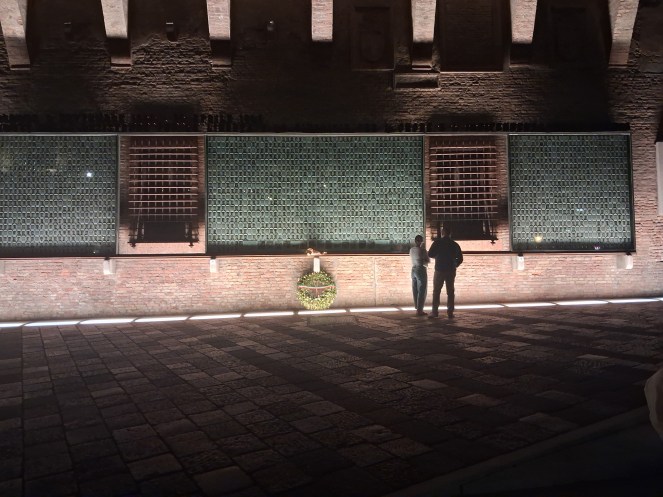
The photos of partisans that look out at you in Piazza Nottuno 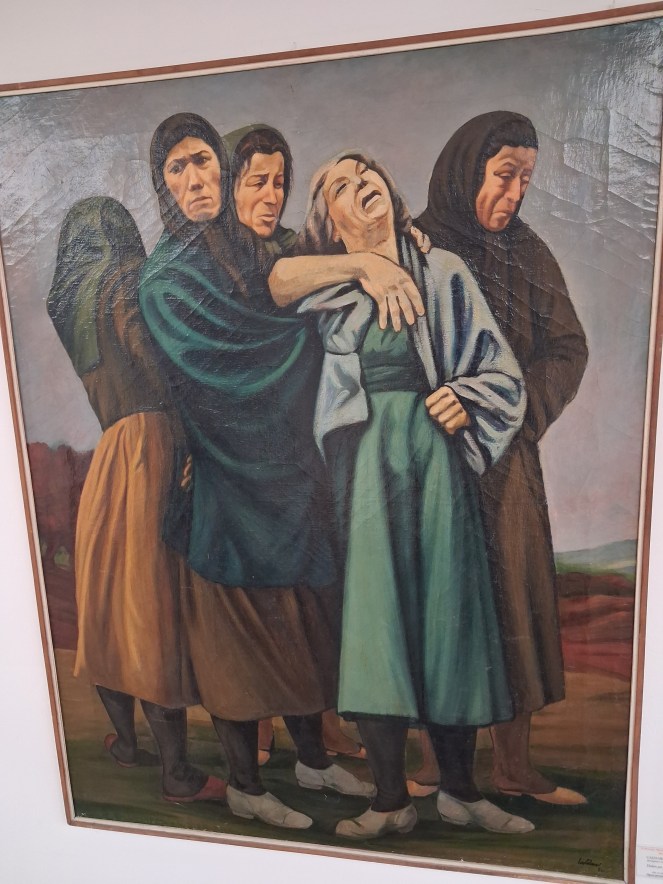
art work is everywhere in Council halls. This appears in Mazobutto Town Hall 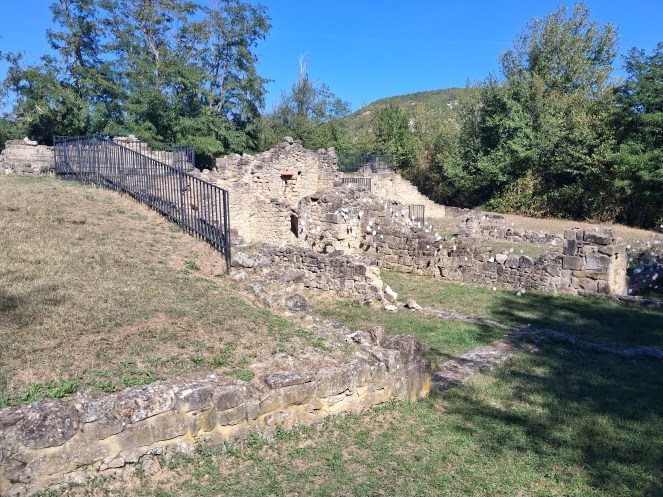
Church remains in the wider region of Monte Sole 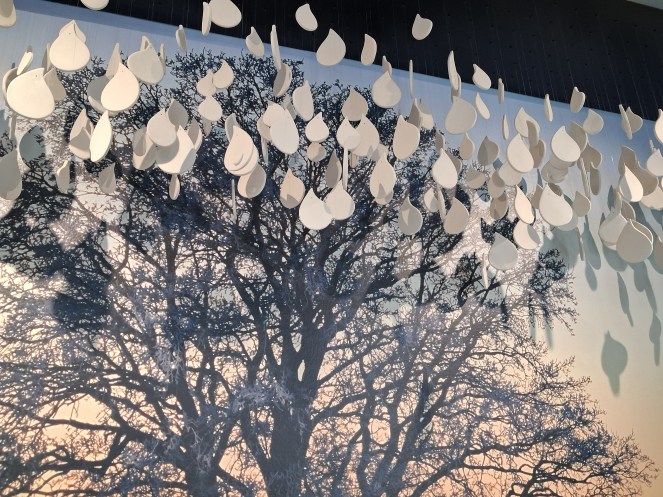
memorial ‘tear drops’ left by children visiting Monte Sole 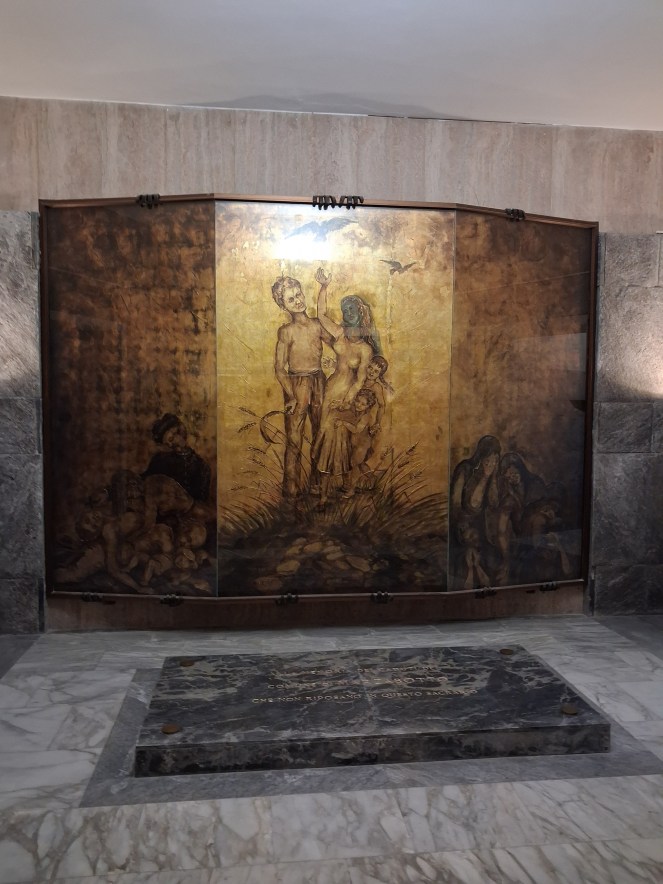
the memorial to the fallen 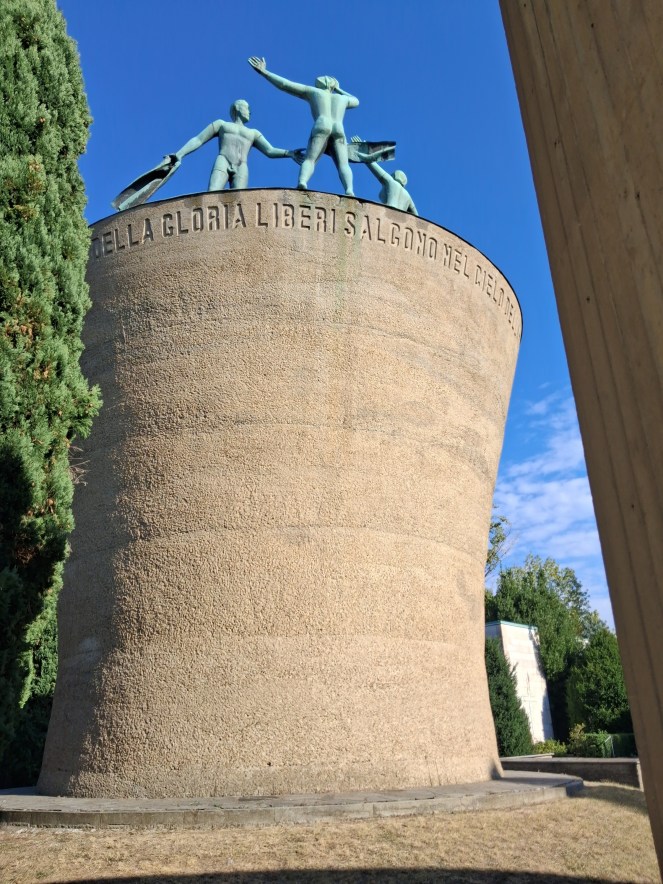
The view on approaching the fallen partisan monument in the civic cemtery 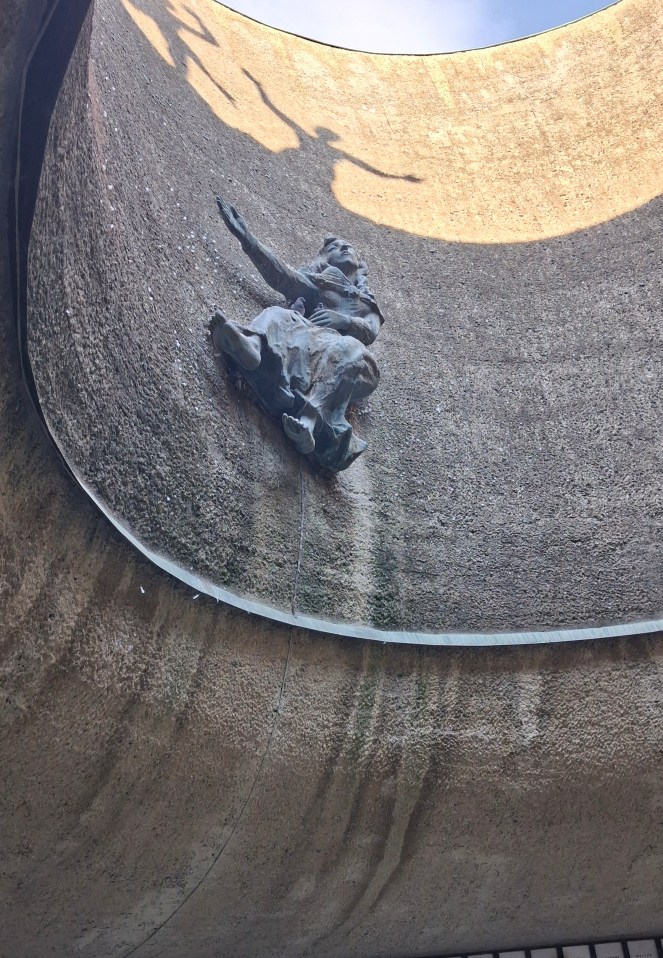
inside the memorial in the civic cemtery
During the Fascist occupation this part of the building had been used for executions and for displaying the bodies of resistance fighters. On 21 April 1945, the day Bologna was liberated, relatives began bringing photographs of those who had died and attaching them to the wall. What had been intended as a place of intimidation was almost immediately reclaimed as a place of remembrance.
Ten years later, in 1955, this spontaneous memorial became the permanent Sacrario dei Partigiani. More than 2,000 partisans are named there, most represented by a photograph on a ceramic plaque. The effect is very direct. Instead of an anonymous monument you find yourself looking at individual faces.
There is an interesting contrast with another memorial we visited at Bologna’s monumental cemetery, the Certosa.
The Monumento Ossario ai Caduti Partigiani was designed by the architect Piero Bottoni and completed in the late 1950s. It is a much more consciously designed work of remembrance. You descend into a stark, enclosed space with associations of a crematorium and death, before rising again towards daylight, peace and freedom.
Inside are the individual resting places of Resistance fighters. It is not simply symbolic: it is a genuine ossuary containing their remains. In 1961 the remains of victims of the Nazi concentration camp at Gusen in Austria were also placed there.
The two memorials seemed to me to complement one another. The wall in Piazza Nettuno grew out of families making their private grief public; the memorial at the Certosa is a deliberately designed work of architecture. One gives you faces, the other gives you a space through which to move.
Our next visit took us outside Bologna to the small town of Marzabotto and the hills of Monte Sole.
Here, between 29 September and 5 October 1944, German forces carried out a series of massacres in which around 770 civilians were killed across dozens of settlements and isolated farms.
Monte Sole was strategically important and the partisan Stella Rossa, or “Red Star”, brigade was active in the area and had strong roots among the local population. German forces entered the region as part of a major anti-partisan operation. But by the time they arrived, many of the partisan fighters had dispersed.
What followed became, instead, a systematic attack on the civilian population. Houses were burned, livestock taken and inhabitants killed. It has been described as a “war against civilians”: an attempt to destroy the human and territorial environment in which resistance could survive.
That makes Monte Sole rather different from Lidice near Prague, with which Coventry also has links. Lidice was destroyed as an explicit reprisal following the assassination of Reinhard Heydrich. At Monte Sole, civilians were swept up in a broader anti-partisan clearance operation and were themselves treated as part of the enemy environment.
One of the most disturbing places is Casaglia.
Around a hundred local people, many of them women, children and older people, gathered in the Church of Santa Maria Assunta in the hope that it would provide sanctuary. German SS troops arrived and forced most of them out towards the nearby cemetery. There they were killed with machine-gun fire and grenades. Four people were killed in or around the church itself, among them the young priest Don Ubaldo Marchioni.
Today much of the memorial landscape of Monte Sole consists simply of the ruined churches, farmhouses and settlements themselves. Their emptiness is part of what makes the place so affecting.
In Marzabotto itself is the Sacrario ai Caduti di Marzabotto, where remains recovered from the wider area were eventually brought together and interred in a single place of remembrance.
Nearby is the Church of Saints Giuseppe and Carlo, built after the war. The role of local priests forms an important part of the story of Monte Sole. Many remained with their parishioners, sheltered people, tried to intervene with soldiers, comforted the wounded and dying and, later, helped recover and bury bodies. Several were themselves killed.
One was Don Giovanni Fornasini of Sperticano. He repeatedly intervened on behalf of civilians and prisoners and continued helping survivors and burying the dead after the main massacres. On 13 October 1944 he was killed after returning to the devastated area. He was beatified in Bologna in 2021.
More recently, on 27 September 2026, three other priests associated with the Monte Sole massacres were beatified in Bologna’s Basilica of San Petronio: Don Ubaldo Marchioni, Don Elia Comini and Father Martino Capelli. All three had remained with people caught up in the violence and were killed in 1944.
What struck me throughout the visit was how present these events still are in Bologna and the surrounding area. This is not simply a matter of preserving old monuments. The anniversaries are still marked, the stories retold and the meaning of the events debated and reflected upon.
We happened to be there for the 82nd anniversary commemorations.
At Marzabotto there is an inscription which perhaps captures the purpose of all this memorialisation better than anything else:
“Ricordate e meditate il nostro sacrificio.”
“Remember and reflect upon our sacrifice.”
I found that particularly moving. It does not simply ask us to remember those who died. It asks us to think about what happened, why it happened and what remembering it might mean for the present.
To find out more
For those interested in learning more about Monte Sole and how the events of 1944 are remembered today, there are several useful websites. The Monte Sole Peace School is particularly interesting for its work in connecting the memory of the massacres with contemporary questions of peace and reconciliation. The Monte Sole Historical Park provides historical information and details of the memorial sites, while the Nazi Perpetrators in Italy project offers a more detailed historical account, including the ways in which the events have been commemorated since the war.
If interested in the Monument to the Fallen Partisans in Certosa Cemetery go to Cultura Bologna – Ossario dei caduti partigiani This explains the design by architect Piero Bottoni, the symbolism of the monument and its underground burial chambers. For the memorial in Pizza Nettuno go to Cultura Bologna – Sacrario dei partigiani
Michael Hammond


