This is a follow up blog which offers a tourist trail around Bologna city centre.
On my visit to Bologna I took part in an organised walk around the city centre. Of course, you can make your own way around the city quite happily, but on my last day I decided to give a guided walk a try.
We met in Piazza Nettuno, alongside the Palazzo d’Accursio. This has been the seat of Bologna’s local government since the fourteenth century. It is still a working town hall but, rather surprisingly, it is open to visitors. Depending on what is going on in the way of council business, you can visit the courtyard, some of the halls, and see the art hanging inside as well as the special collections. You can also climb the Clock Tower for views over the historic centre, though I did not have time to do this. Outside the Palazzo is the memorial to the partisan fighters which I mentioned in an earlier blog.
In one corner of the square is the Lampione dei neonati. The lamp itself dates from around 1920, but from 2012 it was linked to the maternity wards of the Sant’Orsola and Maggiore hospitals. Whenever a baby was born, staff could trigger the lamp to flash for a few seconds, announcing the birth to the city. I believe it is no longer being used, which, if true, is a little sad.
It is difficult to miss the Fountain of Neptune (Fontana del Nettuno), one of the main attractions in the square. It was created in the 1560s, with the great bronze figure of Neptune by Giambologna, or Jean de Boulogne. Neptune stands high above the fountain, muscular and commanding, with his trident in hand. Around the base are smaller bronze figures associated with the Ganges, Nile, Amazon and Danube, the great rivers of the continents then known to Europeans. Apparently Neptune’s mastery of the seas was also meant to symbolise the authority of Pope Pius IV. Just as Neptune ruled the waters, so the Pope claimed authority over the world below him.
The story everyone seems to know about the statue is that Giambologna resented pressure from the Church to make Neptune’s genitals less prominent, so he created a visual joke. From a particular paving stone behind the statue, Neptune’s outstretched thumb lines up with his groin, making the thumb look like an exaggerated erection. The spot is sometimes called the “stone of shame” (pietra della vergogna). Whether or not the story is true, the stone is a popular viewing point.
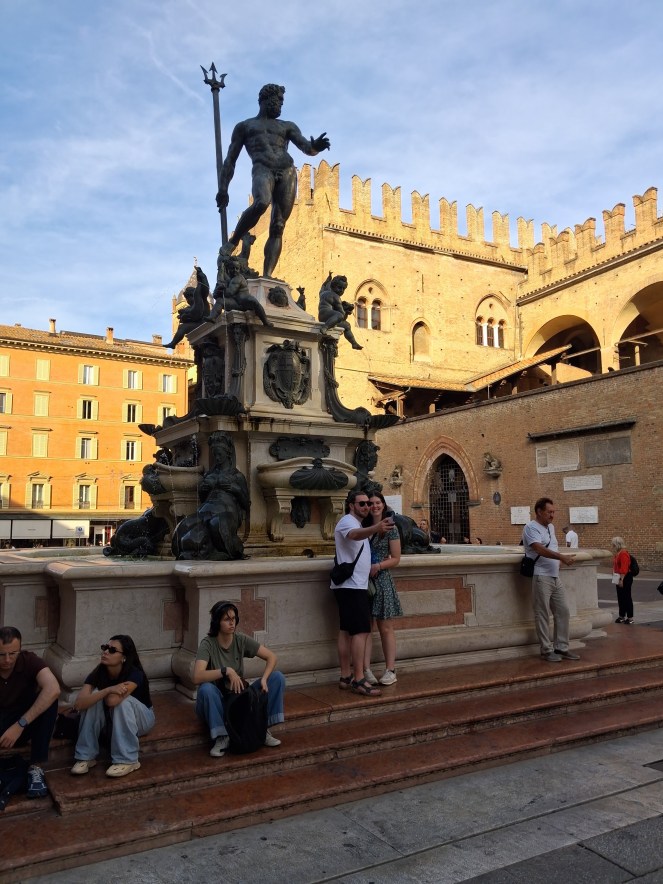
The statue of Neptune in Piazza Nettuno 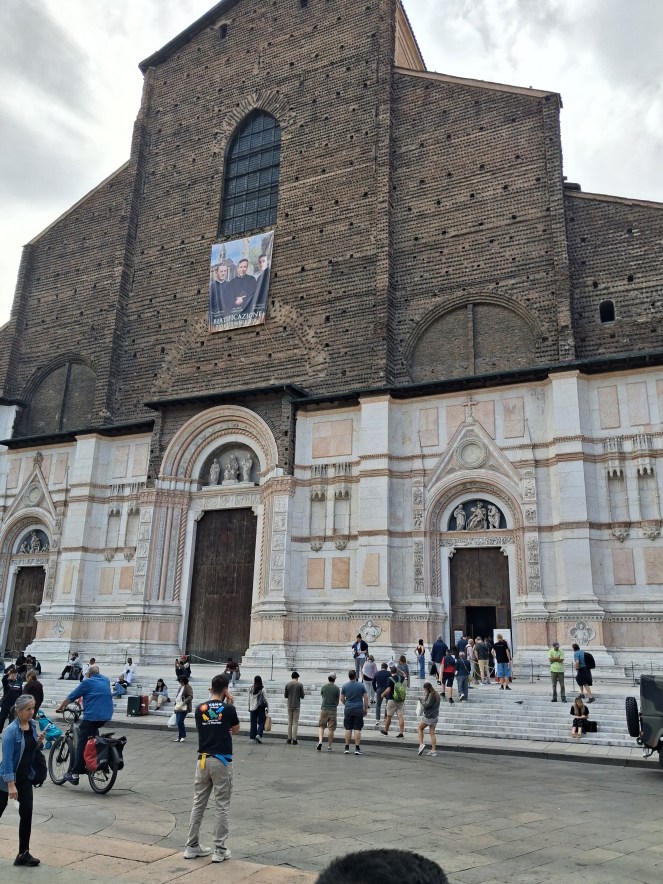
Basilica of San Petronio, a mix of marble and brick 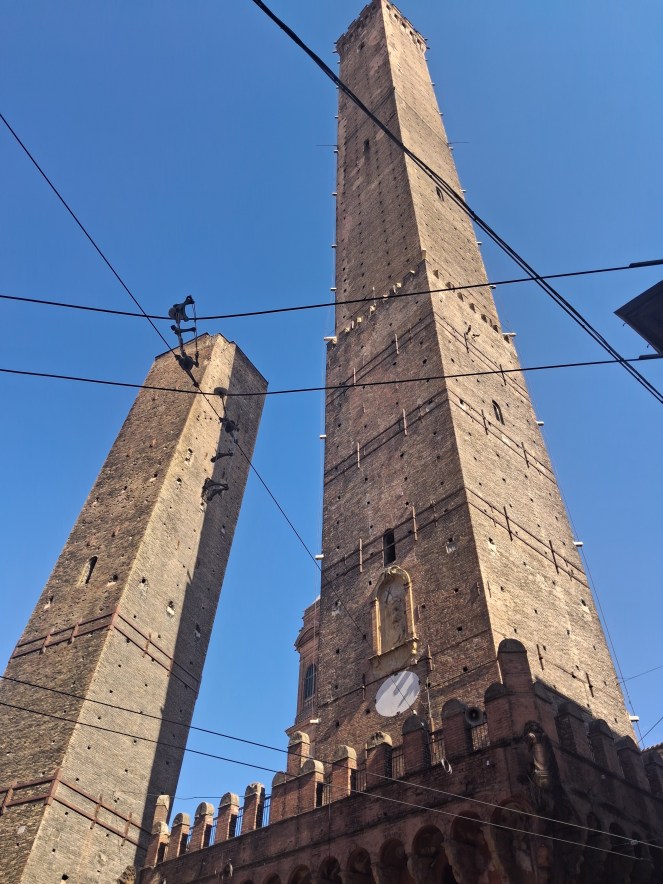
The Asinelli and Garisenda towers in the city centre 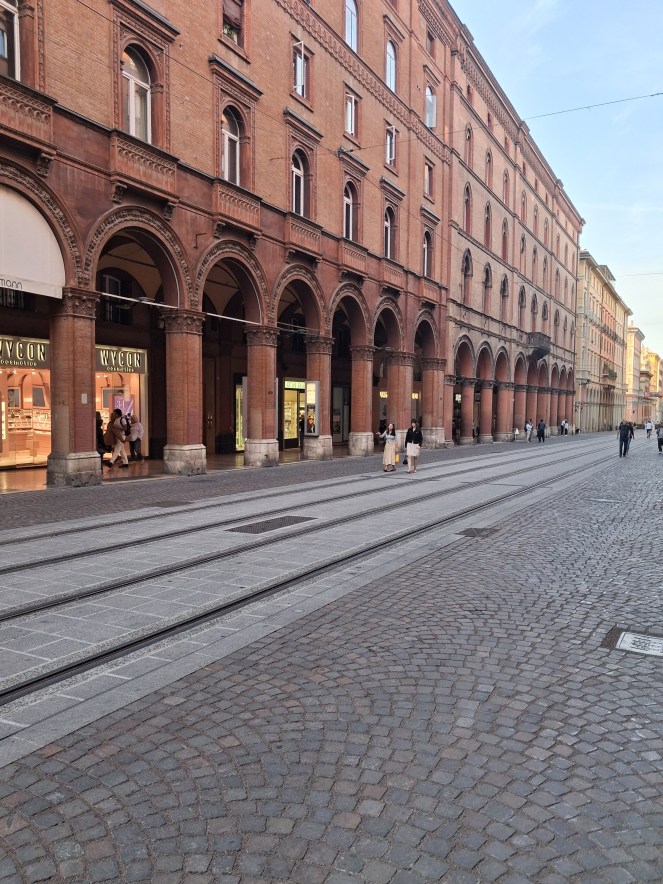
Bologna has over 60 kilometres of covered walkways like this 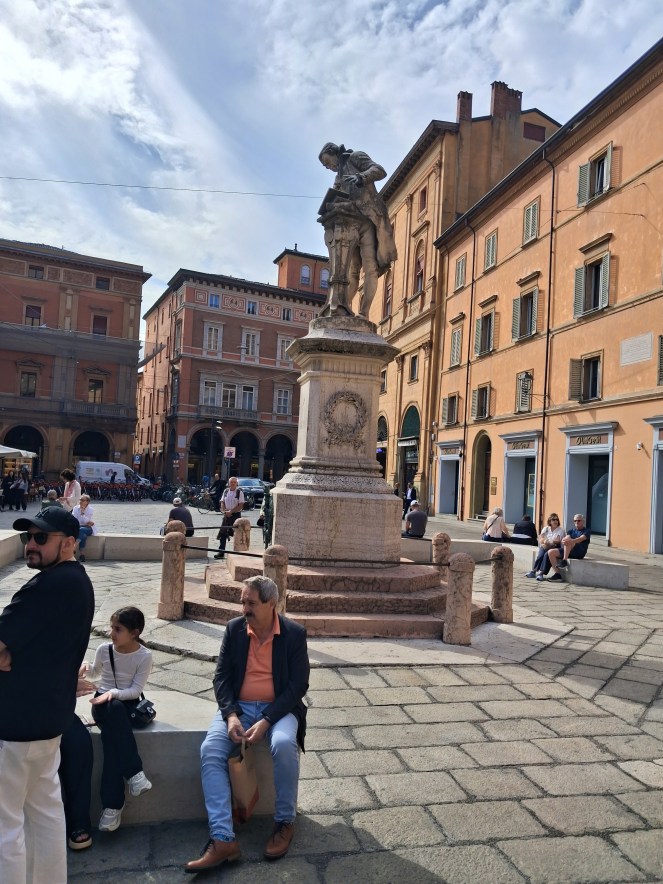
Luigi Galvani from whom we get the word Galvinise 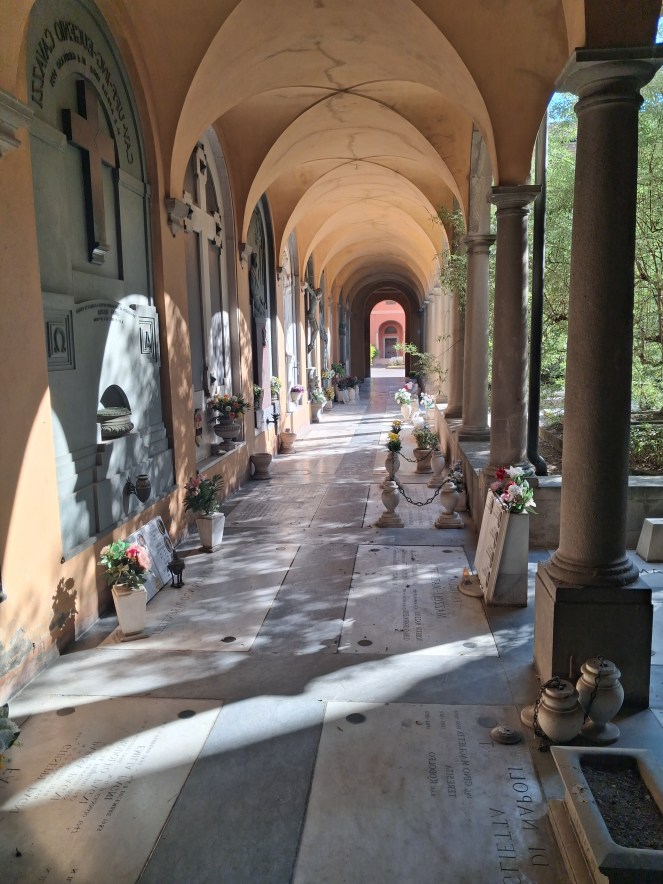
part of the civic cemetery 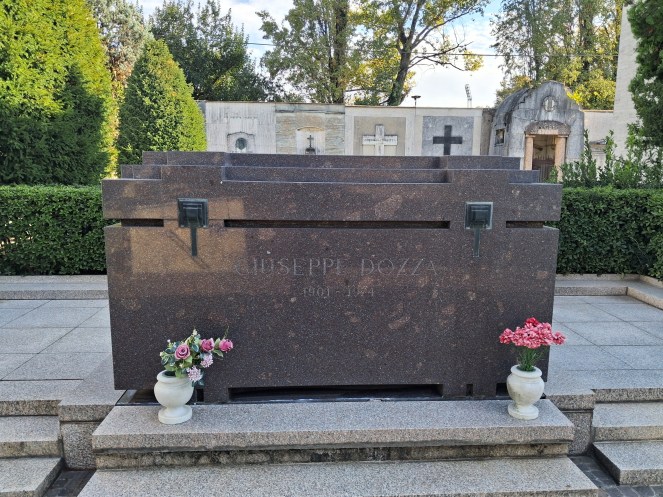
grave of Giuseppe Dozza (29 November 1901 – 28 December 1974) the first Mayor of Bologna after the end of World War II 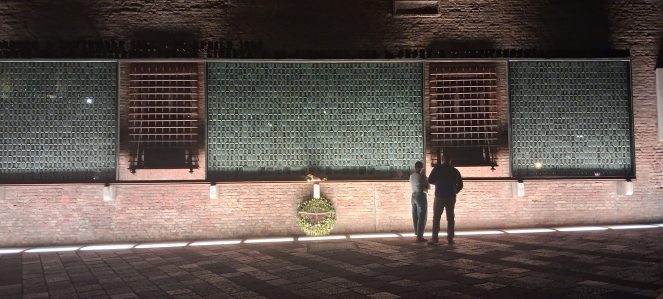
Remembrance in Piazza Nettuno by night
Piazza Nettuno opens onto Piazza Maggiore. The key building here is the Basilica of San Petronio, dedicated to Bologna’s patron saint. Construction began in 1390. The original plans were extraordinarily ambitious, and in the early sixteenth century an enlargement was proposed that would have made the church even bigger than St Peter’s in Rome.
The grand design was never completed. There is a popular story that Pope Pius IV did not take kindly to the idea of San Petronio surpassing St Peter’s and put obstacles in the way. It is a good story, though another explanation is that money and technical difficulties played a part. The most obvious evidence of the church’s incompleteness is the façade: the lower part is faced in white and pink marble, while the upper part remains plain brick. It gives the building a very distinctive, if slightly odd, appearance.
You do not have to walk far in Bologna before coming across one of its surviving medieval towers. In the twelfth and thirteenth centuries there may have been around a hundred of them, built by wealthy families. The most famous pair are the Asinelli and Garisenda towers. Garisenda is very noticeably leaning and is currently being stabilised.
The towers were signs of power and status, but they could also provide refuge in periods of street fighting. Bologna was often divided by struggles between Guelphs and Ghibellines. The Guelphs were broadly aligned with the papacy, while the Ghibellines looked towards imperial power.
There is a Bologna version of Romeo and Juliet connected with these rival families. The Galluzzi and Carbonesi were on opposing sides of the city’s factional struggles. According to the story, Virginia, or Lelia, Galluzzi fell in love with a young man from the rival Carbonesi family and they married secretly despite the feud. When the Galluzzi discovered the marriage, the young Carbonesi was killed. Virginia or Lelia was then found hanged from a balcony. Some versions say she killed herself in despair; others say her family killed her and made it look like suicide. Like many such stories, it has probably been embroidered over the centuries, but it speaks to the family rivalry that surrounded the towers.
A little further on we reached the Archiginnasio, the historic home of the University of Bologna. The university is usually described as the oldest in the Western world. In its earliest centuries it did not have one purpose-built campus. Teachers gave lectures in houses, churches and rented rooms scattered through the city. Only in the sixteenth century were the university schools brought together in one major building.
The Archiginnasio itself was built in 1562–63. Its courtyard and stairways are covered with thousands of coats of arms left by students and university officials. Upstairs is the famous Anatomical Theatre, a richly carved wooden lecture room used for teaching anatomy, with a central marble table where dissections were carried out.
Bologna was an important early centre of anatomical teaching. One of the key figures was Mondino de’ Liuzzi, a professor at Bologna in the early fourteenth century, who helped make the direct examination of the human body an important part of medical education.
As for cutting things up, Piazza Galvani, just behind San Petronio, has a statue of Luigi Galvani, a professor of anatomy best known for his experiments with frog legs in the 1780s. He observed that the muscles in a dissected frog’s leg contracted when the nerves were stimulated electrically. The statue shows Galvani seated and looking down at a frog resting on a book or experimental apparatus.
You can also see buildings associated with Bologna’s old charitable institutions. The Ospedale della Vita cared for the sick and for pilgrims, while the nearby Ospedale della Morte was especially associated with comforting those condemned to death, as well as caring for the ill.
One thing our guide pointed out was the link between the university and another feature you cannot miss in Bologna: the covered walkways. The city is said to have about 62 kilometres of them in total, around 42 kilometres within the historic centre. They are one of the things that make Bologna so distinctive.
These walkways developed partly out of necessity. As the medieval city expanded, householders extended upper floors over the street to create more living space. The growing university and student demand for accommodation added to that pressure. These projecting rooms were supported first on wooden posts and later on stone or brick columns, creating the galleries of today.
The organised tour finished at this point, but I saw two further places of interest that morning.
I mentioned the memorial to the fallen partisans in an earlier blog, but the cemetery itself, the Certosa di Bologna, is well worth a visit in its own right. It is a fair walk from the centre, although there is also a bus.
The Certosa opened as Bologna’s public cemetery in 1801, but the site is much older. With its tombs, cloisters, arcades, chapels, halls and courtyards, it has sometimes been described as a small city of the dead. More than 200 artists worked there over two centuries. It was also famous among nineteenth-century travellers: Byron and Dickens were among those who visited and wrote about it.
Finally, a few hundred metres north of the historic centre, at Bologna Centrale station, you can see a clock on the façade that appears not to be working. In fact, it has been preserved in remembrance of the bombing of 2 August 1980.
At 10:25 that morning, a bomb exploded in the station’s second-class waiting room, killing 85 people and injuring more than 200. The station clock was damaged in the blast and later fixed permanently at 10:25, the moment of the explosion. Inside the station there is also a plaque naming the victims and preserved physical traces of the destruction.
Each year on 2 August at 10:25, Bologna marks the anniversary with train whistles and a minute’s silence. The investigation was slow and complex, but the bombing was eventually attributed by the Italian courts to neo-fascist terrorists associated with the Nuclei Armati Rivoluzionari, or NAR. There were also convictions for attempts to obstruct and misdirect the investigation.
It was a sobering end to the morning.
You can find out more about the places mentioned below:
- Bologna Welcome– the official tourism site, useful for opening times, tickets, guided walks and current access information.
Bologna Welcome - Palazzo d’Accursio and the Clock Tower– particularly useful because access to the historic rooms can vary according to council business.
Palazzo d’Accursio visitor information - Basilica of San Petronio – the church’s own site, with information about the basilica, chapels and Cassini’s meridian line.
Basilica of San Petronio - Archiginnasio – particularly good for information on the Anatomical Theatre and the university’s historic buildings. Biblioteca dell’Archiginnasio
Archiginnasio and Anatomical Theatre - The Porticoes of Bologna – the UNESCO page explains why the porticoes are historically significant and identifies the 12 sections included in the World Heritage site. UNESCO World Heritage Centre
UNESCO: The Porticoes of Bologna - Certosa di Bologna– visitor information, opening hours and background to the monumental cemetery.
Certosa di Bologna visitor information - Bologna station bombing memorial – Bologna Welcome has a particularly useful page explaining not only the bombing but where visitors can see the stopped clock, victims’ plaque, damaged wall and Platform 1 memorial.
Bologna, 2 August 1980: the events and the memory
Michael Hammond


