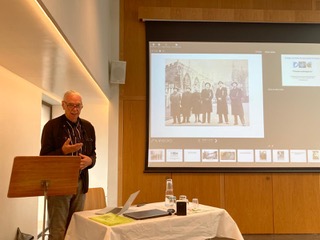
In September 2026 Dave Hirons spoke to Coventry German Circle about CAIF on the 80 anniversary. The talk was centred on Irmgard Rode’s story. The story takes place in Germany in the turbulent years between the two world wars. Born into a Catholic and strongly pacifist family, she grew up as the Weimar Republic gave way to National Socialism and later experienced the losses and upheavals of war at first hand. These experiences, shared with her husband Alfons, helped shape a lifelong commitment to peace and reconciliation. In this section of the talk, we look at the background to Irmgard’s life and at the path that eventually brought her into a close and lasting relationship with Coventry. The full talk is available at the foot of the page.
Irmgard was a Catholic from Meschede in the Hochsauerland and was of what most people would regard as left-wing political inclination. She was born Irmgard Anna Paula Beckmann on June 29, 1911, in Hüls, on the outskirts of the small town of Marl about 50 kilometres north-west of Dortmund. She was the eldest of five children born to the Catholic schoolteacher Joseph Beckmann and his wife Theresia. Joseph Beckmann was born in 1886 and, after World War I, he became the headmaster of the village school in Kinderhaus, near Münster. Irmgard’s parents were married in 1910 and were avowed pacifists, a trait much inherited and embraced by Irmgard. Two of Irmgard’s brothers, Ivo and Egon, were to die as soldiers in World War Two, in 1943 and 1944 respectively.
Growing up Irmgard helped her parents by supervising and caring for her younger brothers and, after completing her secondary education, she worked as a nanny. Her early years, obviously, took place against the backdrop of the turmoil which Germany experienced after the defeat in 1918 – the Weimar Republic and the rise of Hitler’s National Socialists.
In 1937, she married the lawyer Dr. Alfons Rode (1901–1987), who was ten years her senior.
After completing his own secondary education, Alfons Rode – who also came from a Catholic-pacifist family background – studied law and political science in Münster. While still a student he joined the Peace League of German Catholics (Friedensbund Deutscher Katholiken [FdK]), an anti-war movement founded after World War I to promote pacifism and Christian reconciliation. Alfons may have been influenced by his future father-in-law, Joseph Beckmann.
From around 1930 onwards, the Nazis began making inroads into rural areas, violently disrupting their opponents’ events. Members of the Catholic Merchants’ Association, workers’ associations, and other groups formed a “Catholic League” and Alfons Rode became active as the leader of the local branch in Kinderhaus. He said:
The group was strongly religious in orientation; together with the group from Münster and those from other localities around the city, we provided security at many election rallies – particularly in Münster – and engaged in brawls with rampaging Nazis in connection with these events. Even at events preceding the seizure of power, the police stood by idly while such disturbances and fights took place. Because of my position in the ‘League’ and my conduct as an opponent of the Nazis at their events in our village, I was particularly loathed by them – especially by the local group leader.”
By the time the National Socialists came to power in 1933, Rode had already completed several stages of his legal traineeship and even finished his doctoral thesis in law. However, the new regime placed major obstacles in his path regarding the upcoming “Assessor” examination – the final state exam for lawyers)
Candidates were required to spend weeks in camps for paramilitary training and ideological indoctrination as the Nazi judicial apparatus sought to mould a new generation of lawyers that aligned with its own agenda.
Rode demonstrated strong academic performance but repeatedly failed the examination due to his known unreliability regarding his worldview. Nevertheless, thanks to the “special intervention of the President of the Regional Court in Münster,” he gained entry into the senior administrative judicial service and was ultimately able to pass the inspector’s examination in Hamm in the summer of 1936 with top marks.
He was at the same time a leader of the Kinderhaus group of the NS-Reich Air Raid Protection League – founded in April 1933, by Reich Aviation Minister Hermann Göring – and this went in his favour, serving as a “substitute” for his lack of Party membership.
Irmgard and Alfons settled in Meschede in 1937, the year that they married. In November 1938, Dr. Rode witnessed the smashing of Jewish merchants’ shop windows in Meschede and saw Nazis driving a lawyer named Aloys Entrup through the streets, taunting him as a “lackey of the Jews.” Within his close circle of acquaintances, people often “clenched their fists in their pockets” in silent anger but saw no possibility for public protest – especially after the outbreak of the war. Alfons was forced to leave the Sauerland region:
“In the winter of 1940/41, I was seconded to the German judicial administration in Litzmannstadt (Łódź) and was conscripted into the Wehrmacht there in the early summer of 1944. In the spring of 1945, I was taken prisoner by the French in the Black Forest; after two years of captivity, I returned to Meschede. A few months later, I was able to take up my post at the Meschede District Court.”
From late 1940 onwards Irmgard Rode had to manage daily life for her family in Meschede without her husband and, as the defeat of National Socialism neared she was involved in caring for wounded soldiers at a military hospital and, immediately after the end of the war, she enjoyed the trust of the British occupation forces. Even before the occupying powers permitted the first free local elections in 1948, they appointed her to Meschede’s municipal and administrative councils. She served on both bodies from the collapse in 1945 until 1948 and throughout her life, she worked tirelessly on behalf of the socially disadvantaged and for international understanding.
In 1947 Irmgard and Josef Rüther were centrally involved in having a Sühnekreuz (Cross of Atonement) erected. This took place on 4th May of that year but it proved to be a controversial act as there was persistent resistance among the population of Meschede to remembering this past with even the local pastor opposed to the erection of it.
The cross was desecrated four times and, subsequently, it was dismantled and buried at a secret location in ground known only to Irmgard and her family. In 1964, a group of students from Meschede managed to locate the burial site and dug it up. As no one showed any interest in the cross, it remained hidden in Irmgard’s garage until 1982, when it finally found its place within the former confessional chapel of the Church of the Assumption of Mary (“Mariä Himmelfahrt”).
Even before the principle of equal rights for men and women was enshrined in the Basic Law – a process that faced considerable resistance – Irmgard was making her mark in Meschede as a self-assured politician involving herself in schools’ and early years policies and in helping with the settlement and integration of the many refugees from the East who arrived in the Hochsauerland region via Meschede. In particular, she encouraged the sharing of traditional folk culture. Unlike in right-wing “homeland” circles, however, she did this not to exclude others but as a means of building bridges between people of widely varying backgrounds. Later, her work in international exchange would also demonstrate that the “regional” aspect holds significance for inhabitants of landscapes across the globe and that, for people shaped by vastly different cultures, discovering this can provide a great source of inspiration. One might suppose that this activity was the precursor to her being an early pioneer of the local Caritas conference.
The integration of displaced persons in the Sauerland region appears to have been be a success but, immediately after 1945, compassion and practical solidarity were by no means a given: the town of Meschede had been largely destroyed by bombing, and the residents themselves were suffering from food shortages. In her search for allies, Irmgard Rode even encountered racist prejudices in some instances, as she later recounted:
“Of course, some of that Nazi mindset still lingered in our community. I was once deeply shaken when an influential person – whom I had asked to help me find work for these people – said to me: ‘We have to be very careful here when people from other areas come to us. We have to be on the lookout to see if they are actually Aryan. Pay close attention. Look, there are some who are dark-haired, and we have to be wary of that. That won’t do. Aryan heritage is extremely important to us.'”
Few people perceived – as sensitively as Irmgard Rode did – that the poison of fascism continued to exert its influence on everyday life for a long time.
PEACE DELEGATES
A party of six people from the state of North Rhine-Westphalia including Irmgard Rode, the only woman, who, in early 1949, came to Coventry to learn about the forms of local self-government and democracy operating in Great Britain at the time.
The leader of the group was Herr Dr. Adolf Flecken, a native of Neuss, near to Düsseldorf, who was appointed to a ministerial post in the then-young Federal Republic of Germany eventually becoming Minister of the Interior and, subsequently, North Rhine-Westphalia’s Finance Minister from 1952 to 1956.
The remaining four members of the delegation were Herr Dr. Smeets, Town Clerk of Lobberich, near the Dutch frontier, Herr Hans Falliner, a local government official from Bonn, Herr Arnold Knipping, Deputy Mayor of Kierape, in Westphalia, and Herr Karl Hetstedt, a local government official of Cologne. Irmgrad Rode was, obviously, the only woman in the group.
During their time in the city the delegation attended lectures given by various officials of the City Council but, importantly, Irmgard seems to have struck up a rapport with Mary Barnes who was the City’s Children’s Officer.
After returning from the visit to Coventry, Irmgard Rode published an article on March 12, 1949, about her experiences visiting England, highlighting the warm hospitality of the city. The friendship which she had struck up with Mary Barnes evolved into a long-standing partnership between Coventry and Meschede, consisting of regular exchanges over the following decades.
Here are some early examples –
Miss Mary Barnes, Coventry City Council Children’s Officer, possibly with a group of young people from Coventry making a visit to Meschede, date unknown.
Mary Barnes and German visitors, with Pastor Sauerwald of Meschede in Coventry in 1963.
Provost Williams took the Cross of Nails from Coventry to Germany, and in a historical meeting with Willy Brandt he asked him to make the Cross of Nails a symbol of confidence between the two nations. Provost Williams received many honours for his international work and was awarded the ‘Bundesverdienstkreuz’.
A group of young people from Meschede came with Irmgard Rode on a visit to Coventry during the 1960’s.
The full talk is attached here.


One thought on “Irmgard Rode and Coventry friendship”