This is the second part of an interview with Richard Parker, a long-standing member of CAIF, and tour guide for Coventry cathedral. He recently visited Kiel and in part 1 he talked about the friendship between Kiel and Coventry. Here, Richard describes the talk he gave at the Nikolaikirche, Kiel.
During your visit you gave a talk…
Yes, I was invited to give a talk in the Nikolaikirche about Coventry cathedral and that was a really good opportunity to talk about twinning as well.
Did many people come?
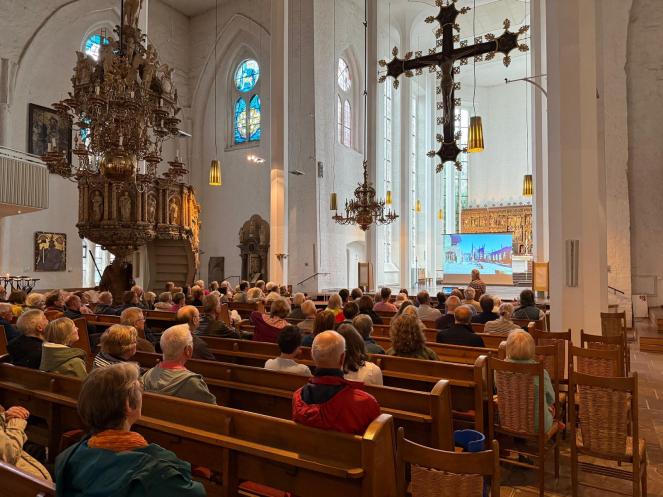
There were around 60 people in the congregation and what I found out was that some had contact with Coventry that go back a really long way. There were people who had visited the cathedral in the 1960s and I had questions about the changing multicultural nature of Coventry and how this affected what we were doing in the cathedral.
What is the Nikolaikirche like?
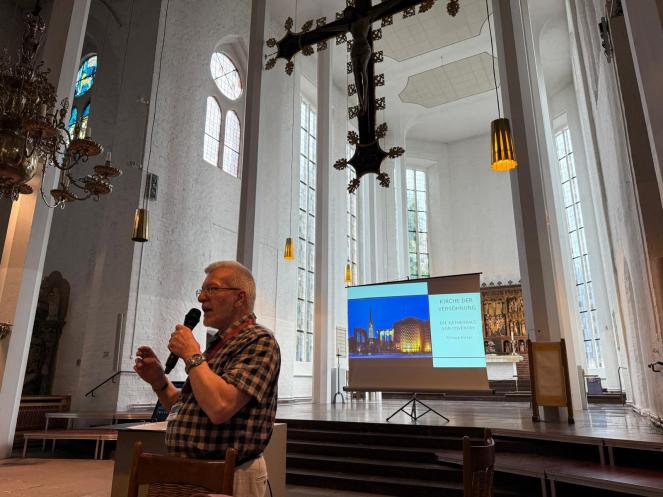
I assume it has been reconstructed but like a lot of German reconstruction they rebuilt it as it was…From the outside it’s a very big, imposing, square church. There is a kind of architectural style in north Germany called brick gothic and you have these beautiful, very, very tall churches in cities around the Baltic coast… Lubeck is an example. So it is a very imposing church. It’s quite dark inside but it has quite a bright chancel so it is easy to talk in there.
And Nikolai I mean that’s Saint Nicolas for us, is that a usual name for the main cathedral?
I think there is a Nikolaikirche in Hamburg used as a memorial, so that is not so unusual and it fits quite nicely with our idea of reconciliation, for St Nicholas was really one of those hands-on saints… there is a story about a group of young boys who were cut up and put into a pot and were stewed for supper, and Nikolai got them out again and brought them back to life. What you make of that is up to you but that was the kind of stories people told about him.
So what did you talk about?
Well, I arranged my talk following the tours that I give here which starts with a bit of history. I first mention St Mary’s priory which survived until 1539 when Henry VIII dissolved the monasteries. But you had St Michael’s Church which was built early 15th century as a parish church, not a monastery. It was one of the largest parish churches in England and in 1918, it was given cathedral status. This was the church that was destroyed in the war and after that we did not have a properly working cathedral again until 1962 when the new building was consecrated. But the ruin was still used for worship.
The new cathedral itself is an extraordinary artistic creation and there is as much interest in its art as its theological space. The architect was Basil Spence and he had a very interesting view about how you should visit his cathedral. You start your visit in the ruins with the memory of the pain and the destruction . As you come into the cathedral you are in the company of angels and saints on the west window, and then you are looking at the altar. Now if you’re an Anglican and you’re in a service with communion you’re going to the altar to be blessed and when you turn round you see the whole magnificence of the cathedral. Important here is that the side windows become visible… and that was Spencer’s intention: when you come in nothing is to distract your attention from the amazing tapestry, only when you turn round from the altar you see the windows and the light shine in.
What do German visitors make of the cathedral?
They are often extremely moved by what they see because they know we’ve absorbed an extraordinary story. We have had some special visitors over time. There was a story that I heard about a middle-aged man who arrived in 1962 during the rehearsals for the consecration service. He went up to the provost in tears and he said I am one of the pilots that did this to you. I’ve just heard that from a colleague who had exactly the same a few years ago with a son of one of the pilots. It must have meant such an enormous amount to him to be able to come here and these are the kinds of contacts that make our work so important. If we just go back to Dresden for a minute there is a parallel story when people and organisations here in Britain raised over a million pounds for the rebuilding of the Frauenkirche and most of that went into the rebuilding and gilding of the cross right on top of the cupola and the guy who worked on that cross was the son of one of the pilots that had carried out the firebombing of Dreden. These are extraordinarily poignant connections.
So what do you how do you see the link with Kiel developing in the future?
Well, as I say Nikolaikirche is part of the cross of nails community and we will carry on liaising and visiting though our shared connection. Of course, the cathedral connection is only one aspect of twinning, there are links between schools and other organisations and people of faith and none. Recently, Aaron Ashmore came to visit some schools in Kiel and I heard that the schoolchildren really loved the talks he gave…. In fact a group from one of the schools he talked to is coming to Coventry next week.
Some people might say the concept of twinning is outdated in this age when we can visit so many different places and we have the Internet if we want to contact people, any thoughts on this?
I think you don’t have to actually visit to get to know people and I was reading an article the other day …it was a review of the book about letter contracts between women in America and women in Russia (‘From Russia with Love: Women’s Pen-Friendships during the Cold War’) and I thought that was really interesting. You start off with platitudes and after that you go into much more kind of personal things and you begin to get a much better sense people’s lives. But there’s nothing that beats a real personal connection and I think we have moved our association with Kiel on.
Notes
The text for Richard’s talk can be found here in English and German.
A background to the Nikolaikirche can be found in Wikipedia:
Wikipedia (ND) St. Nikolai, Kiel [Online] https://en.wikipedia.org/wiki/St._Nikolai,_Kiel
The legend of Saint Nicholas is told in many places including:
Saint Nicholas Centre (ND) The Evil Butcher [Online] https://www.stnicholascenter.org/who-is-st-nicholas/stories-legends/traditional-stories/early-miracles/evil-innkeeper
Photos are curtesy of Dave Hirons

 Coventry Association for International Friendship