Pia Schmeckenbecher is a very welcome visitor to Coventry. She has been working as a volunteer with Coventry cathedral since September 2025 and here she tells us about the organisation that has sponsored her stay and the early links between Germany and Coventry.
Out of all places – why would you choose to come to Coventry for your gap year? As a German, that’s probably the question I get asked most since moving here. To most locals, it seems hardly possible that anyone would pick their city for a year abroad.
And to be quite honest with you – I never really ‘picked’ Coventry either.
The reason I’m here is a German initiative founded in the aftermath of the Second World War.
ARSP (Action Reconciliation Service for Peace) how it is called here in the UK, has been sending volunteers to the City for over 60 years now.But what exactly is ARSP and why is it that connected to Coventry? As an organisation, ARSP has been committed to an agenda of peace and reconciliation since its founding in 1958. But its roots go back even further. Right after the end of World War Two, in October 1945, the Council of the Protestant Church in Germany released an important declaration that was to show a way forward after all that had happened. The so called ‘Stuttgarter Schuldbekenntnis’ (Stuttgart Declaration of Guilt) was an acknowledgement of guilt for the churches collaboration with and toleration of the Nazi Regime.
When Lothar Kreyssig* founded ARSP in 1958, it was with the aim of following up this declaration with concrete actions. Young Germans were therefore sent to countries destroyed by the Nazis to help with reconstruction. By doing so, they were to atone for the crimes committed by the Nazi Regime and help work towards reconciliation and peace. ARSP was and still is meant to be a sign of practical solidarity with countries and people that suffered the Nazi crimes.
As a city, Coventry is a symbol for the destruction that the Nazis brought to the UK during the Blitz. But the city, with its Cathedral and the famous words ‘Father forgive’, also stood for reconciliation and the vision of a shared future. So what better place for ARSP to start their work in the UK than here?
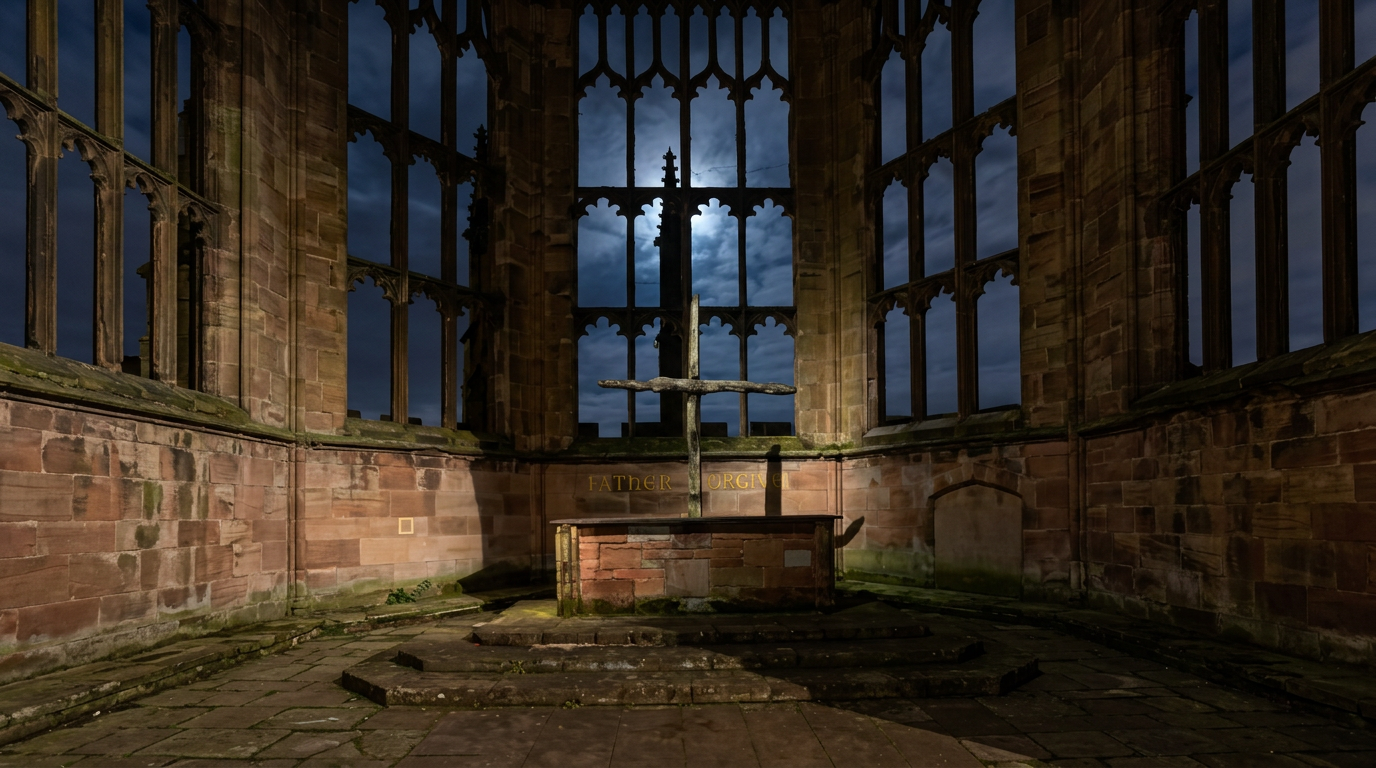
Among the ruins of the old cathedral are a charred cross and the words ‘Father Forgive’
In 1961, only 3 years after the initiative was founded, ARSP sent a group of 16 German volunteers to Coventry to do the reconciliation work Kreyssig had envisioned. During their time in the city, volunteers helped build an International Meeting Centre for Reconciliation in the Cathedral ruins. But they also met with locals and became part of the community.
Not too long after that first encounter, a group of young men from the UK were then sent to the German city of Dresden. This, at the beginning of the Cold War was highly controversial but strongly encouraged by Provost Howard and Coventry Cathedral. In Dresden, the British volunteers helped in rebuilding parts of a hospital that had been destroyed during the allied bombings at the end of the war. Looking at it today, this was the beginning of a longstanding partnership between Coventry and Dresden (that many readers might be familiar with) and also the beginning of the relationship between Coventry Cathedral and ARSP.
Since the early days, the volunteer programmes offered by ARSP have evolved significantly. More than eighty years after the war came to an end, volunteers are still sent to former ‘enemy countries’ to carry out reconciliation work. This includes various European countries such as the Netherlands, Greece and France as well as the US and Israel. Placements in Russia, Belarus and Ukraine are currently on pause.
The reconciliation work that today’s volunteers do though, has little to do with past programmes. Instead, they now work in a variety of different areas, depending on interests and strengths. Some volunteer in care homes others work in archives, former concentration camps or war memorials. There are also volunteer in cultural centres and political or religious organisations. Just as Kreyssig envisioned in 1958, the aim still is for them to make a small contribution to the work towards reconciliation and peace in old as well as new contexts.
In the 1980s, the programme looked like it might fold due to financial pressure. However, in the 1990s it developed greater momentum and 16 or so volunteers were sent to the UK yearly, working mostly in economically deprived communities in the midlands, Devon and the wider London area.
Unfortunately, in consequence of the UK leaving the European Union, in 2025 most organisations in the network were unable to host volunteers due to enormous costs and cuts in EU funding. Speaking of today, only two of ARSP’s posts in the UK remain: two volunteers at Coventry Cathedral.
And this is where my own story begins. But that might be one for another blog entry…
Pia
*Lothar Kreyssig became a judge at the district court in Brandenburg an der Havel in 1937, dealing with custodianship matters. When he became aware in 1940 of the systematic murders of people with illnesses and disabilities in hospitals and institutions, he protested. Lothar Kreyssig was the only German guardianship judge to oppose the Nazi euthanasia programme. You can find out more at various web sites including Stille Helden (Silent Heroes) https://www.gedenkstaette-stille-helden.de/en/silent-heroes/biographies/biographie/detail-129


Well done, Pia!
LikeLike