Several members from Coventry visited Kiel in May this month. We are very pleased to talk to one of these visitors, Richard Parker, a long-standing member of CAIF, and tour guide for Coventry cathedral. The blog is divided into two parts. Part one is about twin cities and part two is about Richard’s talk at the Nikolaikirche, Kiel.
When did you first become interested in Coventry’s twin cities?
Well soon after I started going to the cathedral around the year 2000 …and I joined one of the choirs there. And after a while, they said because I could speak German it would useful if I could train as a guide because we get such a large number of German visitors to the cathedral.
At first, I thought ‘I know this cathedral I’ve been here for years’, but when I trained as a guide I realised there was just so much more that you could pick up and make it interesting to people. I’ve been a regular guide for visiting groups of tourists, mostly, from Britain and from all over the world. We still get a large number of German visitors because that follows on from our history of the war and the idea of reconciliation that we developed after all the destruction. So it’s using my language for something else rather than just me and I find the more I found out about the city the easier it was to lead the tours. So that is what I do. For example, this month I have three or four tours to give and in fact next Wednesday there is a group from Kiel, that is school children coming to Coventry.
So the twinned cities interest just rose naturally from your work in the cathedral and doing tours with German visitors?
Yes and because twinning in Coventry has such a fascinating history. It really is a fundamental part of Coventry.
The first friendship we had as a city was with Stalingrad in 1944 and that was a connection between the women of the two cities. This was an extraordinary moment, though we were not officially twinned until after the war.
We were twinned with Kiel in 1947. After the war we got an invitation from the mayor of Kiel to come over and create some kind of friendship link.
The next twin we had in Germany was Dresden and twinning with them came later in 1959 perhaps because we were a bit slow in picking up what had happened in Dresden and what it had done. It is an extraordinary place and the fact that we were twinned with them in 1959 is a miracle in itself because they were in the middle of their history as part of the German democratic republic (GDR). They were at that time very far away from us in every sense except that both Dresden and Coventry had been destroyed or bombed heavily during the war that was the connection that really brought us together. That and the fact that their church, their Frauenkirche, was damaged just like our cathedral. In fact, the rebuilding of their church could only happen after ‘die Wende’ (this was the ‘turn-around’ or reunification of Germany 1989–1990) and that was an extraordinary symbol for Dresden, for the reunited two halves of Germany, for Europe, and of world-wide interest really. It was a symbol of coming together… of cooperation for rebuilding society… and it was an amazing experience to go there the first time and to see just what they had done.
Like many German cities, Dresden put a lot of weight on the anniversary of their destruction and for Dresden that is the 13 February and now every year we have a group from Coventry that will go and visit in order to be there really. To take part in those ceremonials makes a really live connection with Dresden.
Was Kiel part of East or West Germany?
West Germany and that is key. Because after the war the western areas of Germany were divided up into three areas of control and the northern part was the British area and the administrator who came in to lead the reconstruction was a Coventrian (Gwillym Williams). He was so aware of what had happened to Kiel that he made a real impression in the city and made close connections with the mayor (Andreas Gayk) and that’s really where the idea of twinning with Coventry came from. Not just with anywhere but with us. This led to a visit to Kiel in 1947 which included George Biggs the mayor and Provost Howard. It was through this that Mayor Gayk helped set up the Society of Friends of Coventry.
Provost Howard was a key figure in this, is that right?
Yes, he had a very profound Christian belief shown in his response to the bombing of Coventry in November 1940 that we must not have any thoughts of revenge. We were not in the war just to get our own back. That doesn’t mean that we’re going to let things happen, he believed we had to work really hard and fight hard to win the war so this is not a question of pacifism we must beat the enemy. But we must not think we’re superior when we are doing that and we need to take some steps to create a better world after the war… after all this destruction. He gave a live Christmas Day broadcast in 1940 saying we must create a better, kinder, more simple and more Christchild like world. So that was where he was coming from. This later became more codified into the idea of reconciliation. He believed you did not have to make friends with your past enemies but you had to get to know how they thought to be able to work with them. This could be the idea of taking destructive conflict and turning it into constructive disagreement. Twinning might or might not change minds getting to know each other is a first step.
Does the cross of nail community idea come from Howard?
When Howard first went to Germany* he brought with him the very first cross of nails that he gave to the Nikolaikirche…a tiny cross about 6 inches by 4 and they gave him a stone from their destroyed church and that was the very beginning of the Cross of Nails community. Today, we have a worldwide network of churches, charities, schools and other organisations, all inspired by the Coventry story of destruction and rebuilding and renewal, and all active in reconciliation in their own ways.
Notes
Provost Howard’s reflection on his visit to Kiel in 1947 can be found here:
Laucht, C. (2025) Kiel – Coventry. Beginn einer Freundschaft. Provost Howards Besuch in Kiel 1947 (Kiel – Coventry. The Beginning of a Friendship. Provost Howard’s Visit to Kiel in 1947) Kiel: Ludwig.
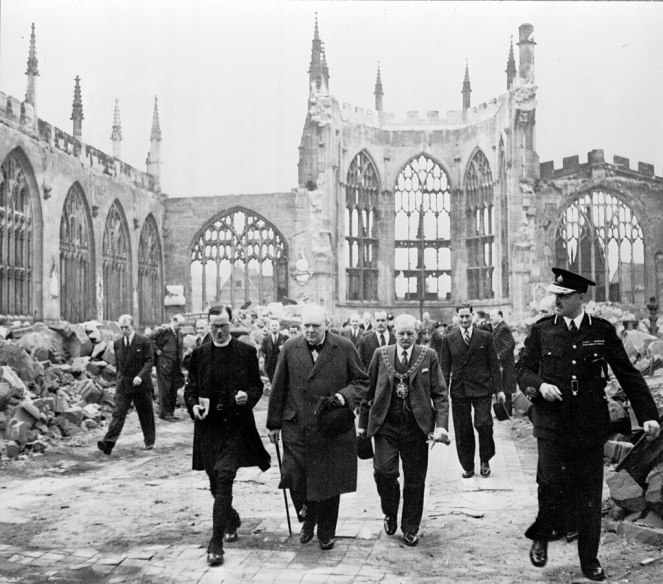
An iconic image of Howard is this one following the destruction of Coventry cathedral after the bombing (the photo is taken by William Horton and it is now in the public domain. Howard is on the left of the screen with the then Prime Minister (Churchill) and the Lord Mayor.
If you want an academic’s take on the post-war friendship between the cities try:
Laucht, C. and Allbeson, T. (2024) Urban internationalism: Coventry, Kiel, reconstruction and the role of cities in British–German reconciliation, 1945–1949. Urban History. 51(4):683-708.

 Coventry Association for International Friendship