Dave, Linda, Penny and myself visited Cork over the St Patrick’s day weekend. I had never been there before and this is some of what I learnt.
If you come to Cork from Coventry what you notice first of all is the river. Coventry has two mains ones but they do not play a central role in the city. Cork has one, the river Lee, though it seems like there are two as the river divides around the city centre. This means that in Cork, you are never far from water.


You are never far from the river
The hills provide a further contrast with Coventry. This creates some stunning views for those that look down on the city. This also means that there are some markedly steep streets as well.

There are also some long streets and Blarney Street claims to be the longest street in Ireland.

Given its geography Cork is, not surprisingly, susceptible to flooding, most recently in 2024. How to protect against flooding is controversial as the office of public works is proposing higher quayside walls but critics suggest that a tidal barrier together with ecological improvements would better keep Cork’s distinctive character.
There are strong links between Ireland and UK and also between Coventry with Cork. We attended a poetry reading with Jenni, Colm, Catherine, Cedric, Molly, Rosalind, and Stan all of whom had visited Coventry. They covered a host of themes including cycling, dads, fires, football, language, love, magnolias, memory, football and much else besides. All this delivered with rhythm and joy in the spoken word.
The links between Coventry and Cork poets was celebrated through ‘Twin Skies’ a collection from ‘40 poets whose work appears here have each visited their respective twin city on at least one occasion to share their well-crafted words andunique experiences.’ This is available by following the link.

There is a St Patrick’s day parade in Cork, well that is not surprising, but what I did not realise was just what a big thing St Patrick’s day is in Ireland. You wish each other happy St Patrick’s day as you would Happy Christmas. The parade went on and on (in a good way) through the centre of Cork and featured sports clubs, dance and theatre groups, community groups, marching bands.
The whole parade was recorded by the Cork city council (link here but start 30 minutes in) and highlights captured by others including ‘Ireland IE photography’ – theirs is a shared film embedded here from YouTube).
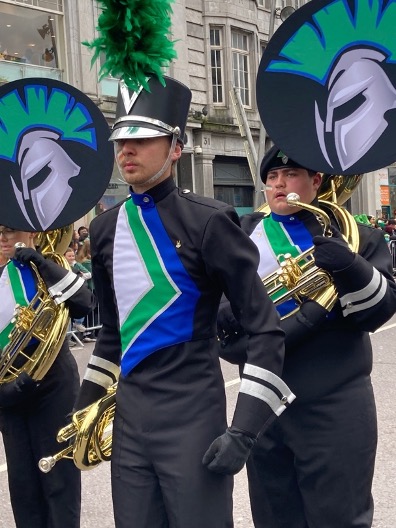
Brass bands

St Patrick – the man who banished the snakes
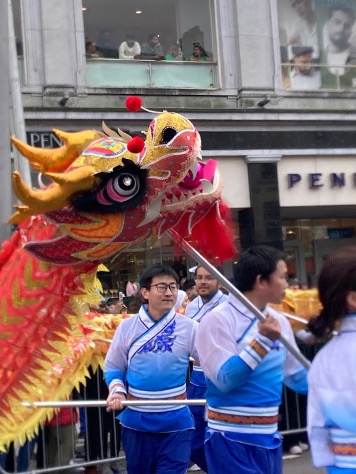

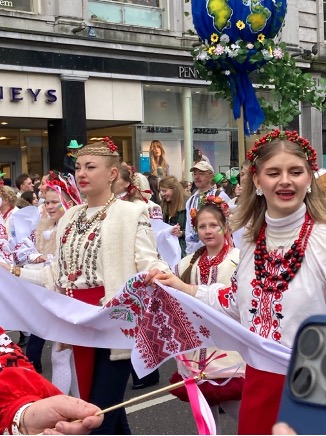
Diversity in Cork: Chinese, Bolivian and Ukrainian new and heritage groups
You expect there to be traditional music in the pub and at events and indeed there is but there are also discos, cover bands and indie groups.

Tuning up outside the café Myo.
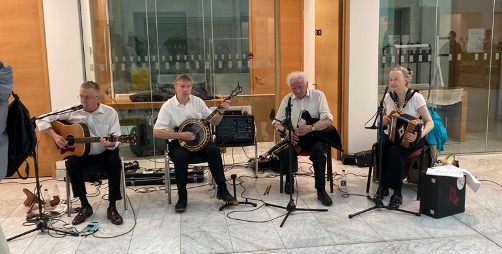
More traditional music at the Lord Mayor’s reception
There is a good rent a bike scheme (tourists can get a three day subscription) to pedal around the the city. As for safe cycling it feels like England, they are trying to do something about cycle lanes but it is a slow business and lanes do not all join up.
Art is a big thing throughout Cork. Big and small. We came across this sculpture on the banks of the Lee, remembering Brian Quilligan who drowned while out fishing back in 2011.

And on a larger scale we came across many murals which were produced during lockdown in Ireland as a kind of outdoor exhibition. Some of these are known as the Ardú Murals and take inspiration from the 100th anniversary of the Burning of Cork by British forces in 1920.
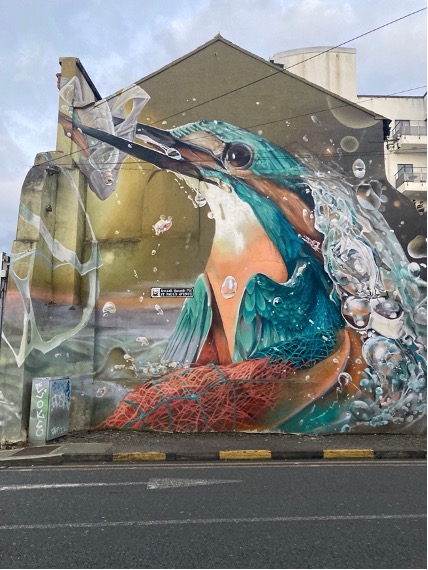
Kingfisher mural on Lavitt’s Quay by Curtis Hylton.
On the subject of fish there is a salmon-shaped weather vane atop the bell tower of St. Anne’s Church. Fish and fishing are an important part of Irish culture. Salmon hold a particular place as they are very wise, at least one was. Children learn about the fable of the salmon of knowledge. There are as many versions of this tale as you care to find but in at least one version a salmon ate hazelnuts from the Well of Wisdom and so gained all the world’s knowledge. But the salmon could not keep this to itself and the first person to eat part of the salmon would gain this knowledge. Well, someone caught the salmon and gave it to his servant to prepare on instructions not to eat any of it. And the servant did not. However, when he was cooking he burnt his finger and sucked on his finger to ease the pain. No problem, but he had previously touched the salmon with his hand when turning it over and so he was the first to eat a part of it. In this unintended way he was the one who received the world’s wisdom. Many adventures ensued.
There are various museums and churches in Cork. We had too little time to visit them all but we did see the restored city gaol, at least restored for visitors. Here were imprisoned the poor, the crooks and republican activitists. The gaol was later turned into a prison for women and later still disused. The top floor of the prison was from a home of the first Cork radio station broadcasting in Cork.
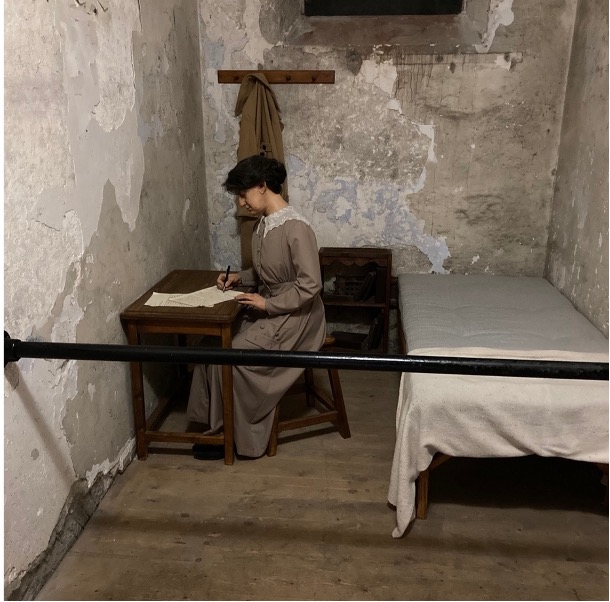
This was the cell of Constance Markievicz, Irish politician, revolutionary and suffragist who was imprisoned for four months in the gaol in 1919 for making a ‘seditious’ speech.
In fact, we had too little time for many things. We did not see all the sites or find out about the politics of Cork or the various sports being played. We did not find out why the market was called the English market, why there was a museum devoted to butter, and learnt nothing about the wider county of Cork. This for another time.

 Coventry Association for International Friendship