We are pleased to publish this blog from Lisa Hagan, head of English at Lyng Hall School in Coventry. While in Dresden, Lisa and colleagues were able to visit the Gedenkstätte Pirna-Sonnenstein (the Pirna-Sonnenstein Memorial) and here she reflects on the visit and the importance of international cooperation today.
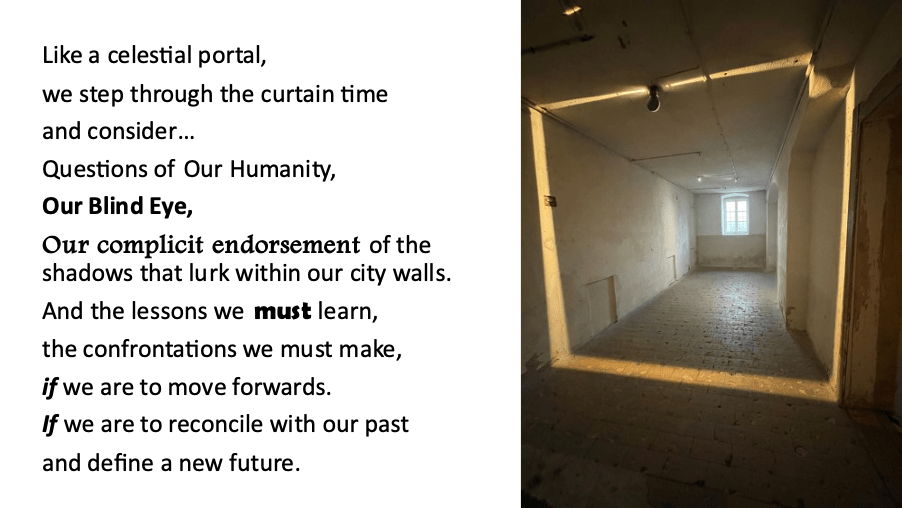
I have been a scholar of Holocaust Education for 21 years but walking through hollow spaces – never fails to overwhelm, daunt and challenge me. It challenges me to consider time and time again how did it happen? How was it possible for human beings to be reduced to such levels of depravity? How was it possible for not only these acts of darkness to be carried out; but for this to be systematically and ‘efficiently’. This haunts our collective memory. It is a chapter we all carry; one we must all study and endeavour to comprehend.
I have been privileged to learn about chapters of The Holocaust in many different places: Yad Vashem in Jerusalem, Auschwitz-Birkeanu in Poland, Bergen-Belsen in Germany, places throughout Lithuania, Liverpool, Nottingham – its footprint is indelible across the globe. So, when Nikolai asked, what part of Dresden would you want to see, I knew in my heart that their place in the Holocaust narrative was essential.
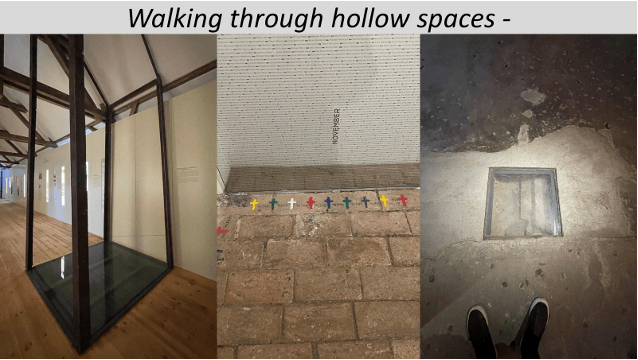
Pirna became such a significant part of my own education and indeed our understanding of this chapter of history. In these photographs here you see the frame of a former chimney. You look at names of those lost to Nazi extremism. You see the floors that once absorbed the screams of so many ends. The place is haunting, silent, and poignantly preserved; enabling their memory to be observed with the dignity they were never afforded under the regime. A dignity enabled by the community who now dwell there – a testament to man’s ability to confront, acknowledge and transform.
Words are the architects of our fate and when these are allowed to be filled with oppressive thought, polarised distortions and deep-rooted hate, a system can be created which robs us of our humanity. This is not the way it should be. But it is only together that we can prevent it from being so.
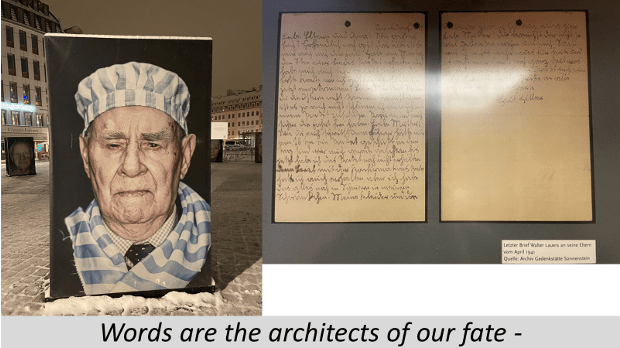
We were ably guided around this space by Uli whose sensitivity, knowledge and time enabled us to fully appreciate other victims of the Holocaust. It was a powerful, and important, day.
Pirna. Before this trip, I am ashamed to say that it was not a name I knew. It was not a place I knew. After 21 years of dedicated study, there were still layers to uncover and expose. I am sure I am not alone in this feeling.
Euthanasia, meaning “easy death” or “good death,” is the practice of intentionally ending a person’s life to relieve suffering. But there was no space for this title here. To dress up what happened as “mercy” devalues the lives that were taken too soon.
In the Spring of 1940, a season typically associated with growth and new life, the National Socialists established a ‘euthanasia’ centre on the premises of the Saxon State Institute Pirna-Sonnenstein. First founded in 1811, this former castle became a killing site for ‘Aktion T4’ – a new site for, in Adolf Hitler’s words the killing of an “unworthy life.”
15 months.
June 1940.
August 1941.
110 employees.
Doctors, nurses, secretaries, bus drivers, burners, policemen.
13, 720 gassed.
Men, women, children.
Our most vulnerable – mentally ill and mentally disabled individuals.
A gas chamber and a crematorium were installed in the basement of what had been a men’s hospital wing – a space for healing rededicated.
We walked through this basement – a coldness that wrapped itself around you. The shadows of the stories it held hovering. We felt the weight of the knowledge absorbed into our skin as we bore witness to the site; becoming vessels of its truth.
And this is only one of six ‘Aktion T4’ killing centres that were active in 1940 and 1941; and each are now homes to the memories of the victims.
But the true depths of the horror, for me, was found in the drawers we opened. The paperwork that was translated for us. The plausible “cause of death” that were detailed and the meticulous concealment of their crimes. The gas chambers camouflaged as “shower rooms.” “Death certificates” sent to the relatives – with a standardised letter of condolence. A narrative that was coldly controlled.
It was not the end. The closing of the extermination site only led to a decentralised approach to the killing.
A further 100,000 were murdered before the end of the war and our theoretical ‘liberation.’ ‘Aktion T4’ later becoming role models for camps whose names are in our vocabulary – Belzec, Sobibor and Treblinka – these sites becoming responsible for 1.75 million.
After passing the gate, the patients were brought to a false hospital ward. It was surreal to be able to walk through the same place; and have the freedom to exit. Walking past the cliff behind the building, where going back 84 years, human remains, and ashes, were casually dumped.
When we walked away from the site, the silence continued with us. There appeared to be a bubble around the site, honouring it as a sanctuary and place of rest. Our light breaks on a new dawn – when we take a moment to stop and pause.
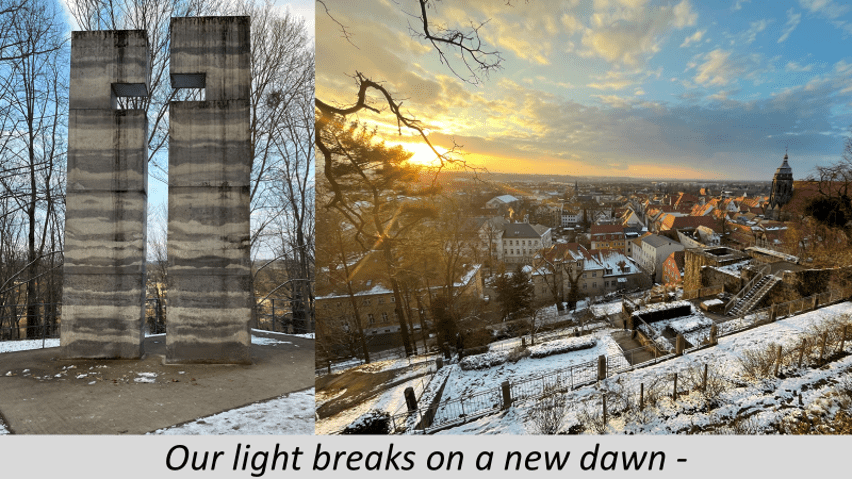
When you visit sites of such utter destruction, taking the time to reflect in space is so vital. This photograph recognises our point of reflection as we endeavoured to process what we had just walked through and learnt. As we look at this memorial, we recognise the salvation that can be found in humanising those lost; confronting the mindset and actions which led to it, and not turning away from the imperative to ensure it does not repeat. We cannot be silent on such matters and I am grateful to Nikolai and Uli who orchestrated this visit and ensure this chapter was spoken.
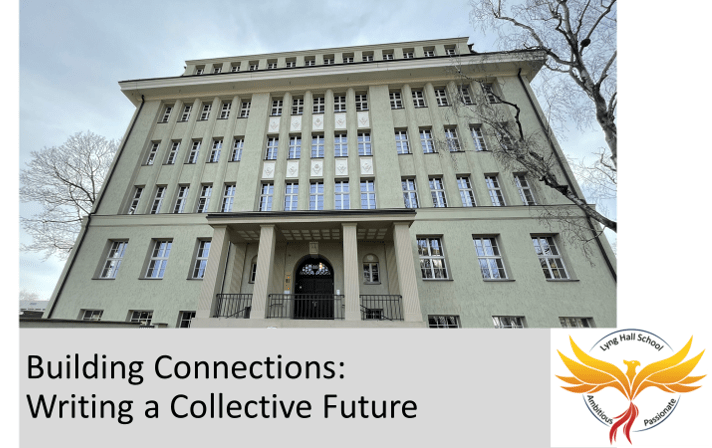
So, what we need to be doing is Building Connections; by doing so we can be Writing a Collective Future. Every time a story is shared, the narrative remains strong, and we participate in the continued liberation of those who suffered and we make possible the absence of such events in the future. We are all ambassadors for these values and it is only through this united vision that we will make our community stronger.
As Ana Blandina, the Romanian poet and essayist, once wrote ‘When justice cannot shape memory, remembering the past can be a form of justice we can choose to be a part of.’ Freedom is fragile and it cannot be taken for granted. I acknowledge that truth, and the partnerships I’ve established with schools in Dresden establish a framework for a conversation. A conversation between young people which places peace, reconciliation and hope at the centre. It is with anticipation that I look to visit Hans-Erlwein-Gymnasium in a couple of weeks; with our online exchange programme launching after Easter; and Franca visiting Coventry for the 85th Anniversary in November. Each of these beginnings are seeds to grow a partnership between our twin cities, our twinned schools – establishing a unified body of young people to guide us towards our future. I am so excited by this possibility and look forward to another opportunity to share with you how it progresses.
I leave you with a final reflection.
Peace.
It feels like a small word but its roots are significant and its importance unmatched. Its French root gives us the idea of ‘permission, reconciliation’, whilst Latin offers us ‘tranquillity, agreement’ but my favourite is Spanish whose root is a “binding.” This sense of an agreement between us that we are committed to ensuring each member of our community has the permission to ‘be.’
If we think of our world now – Gaza, Palestine, Israel, Korea, Ukraine, Syria… The list could continue. If we allowed ourselves to, our view could become very bleak. We could think, ‘but what can I really do?’. If I adopted this attitude in my classroom, I could wash away a future of light. Instead, we need to revisit important words once spoken to renew our resilience for what lies ahead.
Amidst the horrors of The Holocaust, one of the darkest chapters of our collective history, Itzhak Stern cites the Talmud: “Whoever saves one life, saves the world entire.”
And this is the challenge. The mission I set before you.
Lisa Hagan

 Coventry Association for International Friendship
3 thoughts on “Pirna: Remembering the past and writing a collective future”